before the main story
Three Wishes Three Gifts
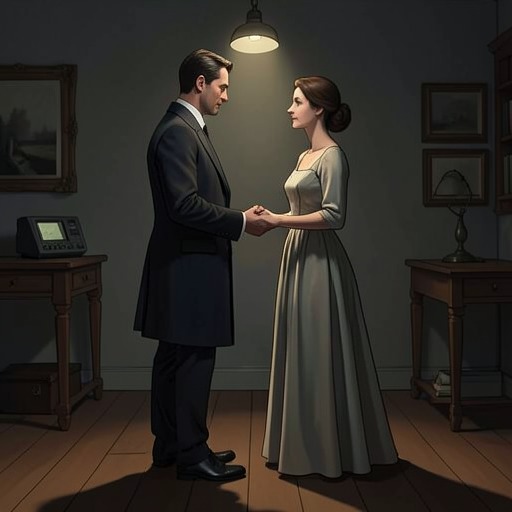
A man with no way out meets a little fairy and makes three wishes to it. The fairy insists that each wish must be exchanged for a gift. It first takes the man's necklace and ring, then asks for the third, which is the most precious gift. The man vows that he will give
decades before the case
The Firstborn Bargain
Della's father was once an orphan and a street thug, with nothing and no status. He made a deal with Rumelstilzkin, obtaining the knowledge needed to become wealthy through wishes, and eventually also obtained the love he longed for. As part of the exchange, he
decades before the case
The Third Wish
After making her first wish, Della's father tried to cancel the deal with his third wish, sending Rumelstielzkin back into the magic lamp. This wish trapped the little genie, but did not erase its right to claim the eldest son in the promise. The father left the lamp
from Della’s childhood to the present
Zaen’s Thousand Proposals
Zain has known Della since childhood. Since she was six years old, he has written a love letter to her every week proposing marriage. For twenty years, Della has always refused him, yet he still keeps her replies, firmly believing she is his true love
shortly before the investigation
The Lamp Is Stolen
The magic lamp disappeared from the hidden room where treasure was stored, and Rumerstilzkin was thus freed. The thief also stole part of the father's treasure, including the elixir of life; the elixir looked genuine, but once it left the elf's territory, it
shortly before the investigation
Della’s Curse Takes Hold
The demands of Rumerstieltzkin began to affect Della's memory and self-awareness. Her father learned that when Della turns twenty-one, the little fairy will come to take her and control the inheritance originally meant for her. The family could not find a clear way to reclaim it
opening scene
A Stranger’s Three Gifts
The story opens with another encounter: a man argues with a small fairy about the conditions for making three wishes. The fairy takes his necklace and ring, then demands the last gift, forcing the man to swear he will do whatever the fairy asks. The man refuses to give up his soul but accepts the
early in the story
The Pigeons Summon Tad
Tade was reading in the small house, and Sef and [Pip](entity:character-recall-character-pip-adcf1b9353d3) were constantly pecking at his window and door. He tried to drive them away, but then discovered that [Nan](entity:character-recall-character-nan-8b3a0b065eb0) had perched among his books and learned that these birds could enter his private room, something he had thought impossible
early in the story
Claire Joins the Case
[Claire](entity:character-recall-character-claire-a8a181f2052b) arrived with lunch and quickly got involved in the unpleasant situation between Tade and the birds. Tade found that someone had entered his small hut and touched the items in the kitchen cabinet; it seemed no valuable items were stolen, and there were no signs of forced entry. Claire guessed the intr
early in the story
The Wager Begins
Tade and [Claire](entity:character-recall-character-claire-a8a181f2052b) argued about which was more effective, romantic intuition or scientific reasoning, when facing a true love case. Tade believed in signs of fate and the power of love; Claire questioned his reliance on intuition and criticized his past performance
the evening the case begins
Dinner at Imogene’s House
[Claire](entity:character-recall-character-claire-a8a181f2052b) told Tade that Imogen invited him for dinner and even specifically found out his favorite is preserved peacock meat. Tade was worried it was a trap, but he reluctantly agreed, and thus had to go to that strange blue house — the orange door was very noticeable. Before dinner
that night in Shub-Haramb
The Yellow-Eyed Figure
Tade went to Shub-Halamb to find Zain, and only arrived after dark. He saw a small person wearing a hood dancing and showing off in the forest, claiming he had already obtained a firstborn, while complaining that the father was bad at math and no one had told the
that evening
Tad Faces Imogene
Tade arrived at Imogen's house and saw a nervous client receiving strange advice about eggs and admirers, then was hurriedly sent out. Imogen realized that Tade also had his own troubles and teased him. [Claire](entity:character-recall-character-claire-a8a181f2052b) insisted that they should continue eating. Imogen told Tade that she wanted
during dinner that evening
The Egg Reading
Imogen produces food and announces that a scheduled customer is coming. [Claire](entity:character-recall-character-claire-a8a181f2052b) seems not to notice this oddity. Tade secretly observes Imogen as she examines an egg for a customer and tells him that two yolks predict a child. After that, she tests his arithmetic and sends him away
the next morning
Claire’s Scientific Challenge
Tade returned to the [Library of Love](entity:location-recall-location-library-of-love-f839de985563), intending to prove he was right; but [Claire](entity:character-recall-character-claire-a8a181f2052b) questioned his romantic interpretation of Zane's repeated proposals. She thought Zane might be under a curse, seeking someone who does not love him, and challenged Tade to re-examine the evidence
the next day in Shub-Haramb
Zaen’s Horse Gift
[Tad](entity:character-recall-character-tad-32dcd4a4c202) watched [Zaen](entity:character-recall-character-zaen-99980c5c88d7) in the marketplace as he led a black horse and told his friend Hisham that he had bought it for Della. Zaen believed the gift would please her because she liked spirited mounts, while Hisham argued that women preferred gold and jewels.
Their conversation also revealed that Zaen had recently come into money, and Tad noticed [Claire](entity:character-recall-character-claire-a8a181f2052b) spying nearby in disguise. Claire explained that a gold necklace she had found in Zaen’s saddlebag appeared suspicious, directing Tad’s attention toward the possibility that Zaen’s new wealth had an illicit source.
the same day
Claire Tests the Necklace
Back at the [Library of Love](entity:location-recall-location-library-of-love-f839de985563), [Claire](entity:character-recall-character-claire-a8a181f2052b) showed [Tad](entity:character-recall-character-tad-32dcd4a4c202) the necklace she had found in [Zaen](entity:character-recall-character-zaen-99980c5c88d7)’s saddlebag. She tested the metal with a powerful magnet and acid, concluding that it was genuine gold rather than a cheap imitation.
The test and Zaen’s sudden ability to afford valuable goods made Claire suspect that he had been dealing in stolen jewelry. Tad was reluctant to accept the implication, but the clue shifted their investigation from romantic misunderstandings toward the hidden treasure and the escaped thief.
the same day
The Letter Shrine
[Tad](entity:character-recall-character-tad-32dcd4a4c202) took [Claire](entity:character-recall-character-claire-a8a181f2052b) to [Zaen](entity:character-recall-character-zaen-99980c5c88d7)’s cramped quarters and showed her the hundreds of letters he had saved from Della. The carefully arranged replies and preserved flowers seemed to Tad like proof of enduring devotion, but Claire saw evidence of a man ignoring repeated refusals.
Their disagreement over the letters exposed the limits of Tad’s romantic assumptions. Claire questioned why [Lady Love](entity:character-recall-character-lady-love-450fd8fb3d25) would pair Della with someone who appeared so heedless of her wishes, while Tad remained convinced that Zaen’s persistence reflected true love.
later that day
The Necklace Is Replaced
[Tad](entity:character-recall-character-tad-32dcd4a4c202) bought a gold necklace for [Roselle](entity:character-recall-character-roselle-70266f16d186) in the marketplace, then acquired a small spinning wheel as a gift for [Claire](entity:character-recall-character-claire-a8a181f2052b). He hid Roselle’s jewelry in a box at home and headed back to the [Library of Love](entity:location-recall-location-library-of-love-f839de985563), believing his presents would help him make progress with both women.
When he gave Roselle the box, she assumed its straw contents were bedding for her missing pet, Mister Tiddledinks. Tad realized that the necklace had been replaced while it was in his possession, and the humiliation made him suspect that a skilled thief had targeted him.
after the failed gift
Tad Questions the Merchant
[Tad](entity:character-recall-character-tad-32dcd4a4c202) returned to the marketplace and paid the merchant for details about the person who had sold him jewelry. The merchant described a young man in a good mood who had traded gold bracelets and necklaces for other items and arrived with a black horse.
The account resembled [Zaen](entity:character-recall-character-zaen-99980c5c88d7)’s circumstances, but it did not prove that he was a thief. Tad began to doubt his own conclusion and recognized that [Claire](entity:character-recall-character-claire-a8a181f2052b)’s suspicion about the necklace might have been more useful than he wanted to admit.
during Tad’s next visit to the De Courville Estate
The Magic Carpet Bites
[Tad](entity:character-recall-character-tad-32dcd4a4c202) followed [Zaen](entity:character-recall-character-zaen-99980c5c88d7) and Della’s father into a bare storage room at the [De Courville Estate](entity:location-recall-location-2f07eaece9f4), where the men disappeared despite there being no visible exit. He spotted a rug beneath a pile of straw and tried to lift it, only for the rug to bite his hand.
[Claire](entity:character-recall-character-claire-a8a181f2052b) examined the rug as a possible living construct and proposed that it guarded something beneath it. Their discovery established that the room concealed a magical barrier, though they did not yet know what lay below or why Zaen and Della’s father had gone there.
after the carpet encounter
The Password in the Drawer
[Tad](entity:character-recall-character-tad-32dcd4a4c202) searched [Zaen](entity:character-recall-character-zaen-99980c5c88d7)’s room and found a ring and a scrap of parchment hidden in a desk drawer. The parchment bore the words “[Open sesame](entity:expression-recall-expression-open-sesame-266d977a80b3),” the same phrase [Imogene](entity:character-recall-character-imogene-de3e2548ef9e) had given him at dinner.
Tad tried speaking the words to the parchment, but nothing happened. He concluded that the phrase might be an access code for the rug rather than a spell to reveal writing, and began to suspect that Zaen was connected to the thefts after all.
immediately after the password discovery
Zaen Mistakes Tad for a Jinn
[Zaen](entity:character-recall-character-zaen-99980c5c88d7) returned to his quarters carrying an old oil lamp and thrust it toward [Tad](entity:character-recall-character-tad-32dcd4a4c202), ordering a jinn to return to the lamp. When the lamp did nothing, Zaen accused Tad of being the wrong creature and demanded that he leave.
Tad confronted Zaen about the gold jewelry and ring, but Zaen denied being a thief and said he had urgent business for Della. The exchange left Tad uncertain about Zaen’s role and introduced the [Magic lamp](entity:object-recall-object-magic-lamp-98e2d5f27606) as a crucial object in the case.
later that day
Claire Explains the Fake Gold
[Tad](entity:character-recall-character-tad-32dcd4a4c202) told [Claire](entity:character-recall-character-claire-a8a181f2052b) that someone had replaced his necklace with straw. She reasoned that the necklace could have been stolen property, and that the merchant might have used a foreign buyer to move goods he could not safely display openly.
Claire also pointed out that the necklace’s price was suspicious: Tad had exchanged a gold coin for a large amount of finely worked gold. Though the money was probably gone, she concluded that the transaction and the straw replacement pointed to a larger magical deception rather than a simple joke.
the following investigation period
The Jinn and the Secret Deal
[Tad](entity:character-recall-character-tad-32dcd4a4c202) told [Claire](entity:character-recall-character-claire-a8a181f2052b) that he suspected a jinn was connected to the [Magic carpet](entity:object-recall-object-magic-carpet-a9c2778e3849) and the lamp, while Claire shared what she had overheard: Della’s parents had discussed a terrible deal with a powerful being. Their separate clues began to converge on the bargain that had put Della in danger.
Claire also revealed that Della’s hand and fortune were promised to someone other than [Zaen](entity:character-recall-character-zaen-99980c5c88d7). Tad resisted her conclusion, but the possibility that Della’s future had been pledged to another party made the case more urgent and less straightforward than a simple curse on true love.
after Tad and Claire compare clues
The Treasure Chamber Revealed
[Tad](entity:character-recall-character-tad-32dcd4a4c202) used the [Magic globe](entity:object-recall-object-magic-globe-91c9393f1a68) to watch [Zaen](entity:character-recall-character-zaen-99980c5c88d7) and Della’s father return to the storage room. The father lit the candles, spoke “[Open sesame](entity:expression-recall-expression-open-sesame-266d977a80b3),” and the [Magic carpet](entity:object-recall-object-magic-carpet-a9c2778e3849) lifted to reveal a staircase descending to a chamber filled with treasure.
Della’s father explained that some of the missing treasure was [Fairy gold](entity:object-recall-object-fairy-gold-a0339661cf2d), which could not retain its value outside the [Jinn](entity:creature-recall-creature-jinn-4e00f1a574cd)’s territory, while real coins and jewels remained in the chamber. The scene confirmed that the father had hidden wealth and that the rug was guarding the secret entrance.
during the same Magic globe viewing
The Parents’ Confession
After leaving the chamber, Della’s father told his wife that he had made [Zaen](entity:character-recall-character-zaen-99980c5c88d7) his treasurer because the young man loved their daughter and could help locate the escaped jinn. He admitted that he had concealed the danger from her because he feared she would think he was using Zaen.
He described the bargain with [Rumpelstiltskin](entity:character-recall-character-rumpelstiltskin-079d67ae3b63), the promised firstborn, and the threat that the imp would claim Della when she turned twenty-one. Della’s mother wondered whether the creature wanted the inheritance or the girl herself, while her husband regretted making a promise whose true cost he had not understood.
late that night
Tad Shares the Deadline
After searching the [Library of Love](entity:location-recall-location-library-of-love-f839de985563), [Tad](entity:character-recall-character-tad-32dcd4a4c202) learned that jinn were unpredictable beings and found a story about a creature who spun straw into gold. The tale suggested a connection to the strange gold and the figure he had seen in the woods, though it did not explain the lamp.
Exhausted, Tad told [Claire](entity:character-recall-character-claire-a8a181f2052b) that Della had less than a day before her twenty-first birthday and that [Rumpelstiltskin](entity:character-recall-character-rumpelstiltskin-079d67ae3b63) intended to claim her. They agreed to work together temporarily and asked the [Magic globe](entity:object-recall-object-magic-globe-91c9393f1a68) to show them where the jinn could be found.
the next day in Shub-Haramb
The Name-Guessing Merchant
The [Magic globe](entity:object-recall-object-magic-globe-91c9393f1a68) led [Tad and Claire](entity:relation-recall-relation-tad-claire-3b666a1dd197) to a merchant inviting passersby to guess his name in exchange for gold jewelry. [Tad](entity:character-recall-character-tad-32dcd4a4c202) recognized the scene as resembling the tale of the miller’s daughter, and the merchant’s childish manner seemed increasingly familiar.
[Imogene](entity:character-recall-character-imogene-de3e2548ef9e) appeared with [Paribanou](entity:character-recall-character-paribanou-8b1b5e924802) and identified the merchant as [Rumpelstiltskin](entity:character-recall-character-rumpelstiltskin-079d67ae3b63). Paribanou exposed his disguise and scolded him for offering humans [Fairy gold](entity:object-recall-object-fairy-gold-a0339661cf2d) and making another firstborn bargain, while the crowd recoiled at the revelation that the merchant was a magical creature.
the same day
Rumpelstiltskin Is Captured
[Paribanou](entity:character-recall-character-paribanou-8b1b5e924802) and [Imogene](entity:character-recall-character-imogene-de3e2548ef9e) confronted [Rumpelstiltskin](entity:character-recall-character-rumpelstiltskin-079d67ae3b63), who had been trying to trade gold for guesses at his name. He resisted being named and complained that people would not give him what he wanted, while his sisters rebuked him for making another bargain involving a firstborn.
They took him into custody and decided that the [Magic lamp](entity:object-recall-object-magic-lamp-98e2d5f27606) should be hidden where humans could not reach it. The sisters’ intervention revealed that Imogene was one of Rumpelstiltskin’s kin and that her apparent witchcraft concealed a magical family’s effort to contain him.
immediately after Rumpelstiltskin’s capture
Della’s Curse Is Lifted
With [Rumpelstiltskin](entity:character-recall-character-rumpelstiltskin-079d67ae3b63) captured, the enchantment that had begun to erode Della’s memory and give the imp a claim over her was removed. [Tad and Claire](entity:relation-recall-relation-tad-claire-3b666a1dd197) understood that the immediate magical danger had passed, though they still needed to ensure that [Zaen](entity:character-recall-character-zaen-99980c5c88d7) and Della could decide their future freely.
The rescue resolved the urgent threat but did not itself create love between the two clients. Their relationship still required the honesty and trust that Della had never found in Zaen’s repeated poetic proposals.
later that day
Zaen Is Brought to Della
[Tad and Claire](entity:relation-recall-relation-tad-claire-3b666a1dd197) found [Zaen](entity:character-recall-character-zaen-99980c5c88d7), told him the jinn had been captured, and demanded the [Magic lamp](entity:object-recall-object-magic-lamp-98e2d5f27606). Zaen hesitated, still clutching the object, but the two agents took him by the arms and transported him to Della’s front door.
[Tad](entity:character-recall-character-tad-32dcd4a4c202) advised Zaen to try a different approach, since his letters and proposals had not shown Della what she needed from him. [Claire](entity:character-recall-character-claire-a8a181f2052b) returned to the [Library of Love](entity:location-recall-location-library-of-love-f839de985563), leaving Tad to watch the meeting through the globe and hoping the couple could finally speak honestly.
near the ending
The Friendship Bracelet
[Zaen](entity:character-recall-character-zaen-99980c5c88d7) met Della beside a fountain and, before leaving her alone if she did not love him, gave her a handmade [Friendship bracelet](entity:object-recall-object-friendship-bracelet-f0f8e4c31ff6). Its strands and beads recalled their history, including the horses, the moments when she had fallen and he had caught her, and the friendship that had shaped their years together.
Della recognized that the bracelet expressed knowledge of who she really was, not an attempt to impress her with wealth. She admitted that she had doubted his love because his poetry praised an imagined ideal rather than showing that he understood her own feelings and insecurities.
near the ending
The Thousand-and-First Proposal
Della told [Zaen](entity:character-recall-character-zaen-99980c5c88d7) that she had wanted to be treasured as a person and trusted as a friend, not treated as a prize to be won through persistence. Zaen understood that his thousand proposals had not conveyed the enduring trust she needed, even though his devotion had been genuine.
He proposed again, asking first to remain her lifelong friend. Della accepted his marriage proposal on the condition that he remain her dearest friend, and Zaen promised that their partnership would be grounded in shared life and cherishing rather than display.
immediately after the engagement
The Hidden Family Story
After Della accepted, [Zaen](entity:character-recall-character-zaen-99980c5c88d7) began telling her about her parents and the jinn of the lamp. His honesty would bring her into the truth about the family’s hidden bargain and the danger that had threatened her inheritance and identity.
The conversation marked a new foundation for the couple: Zaen was no longer trying to win Della through grand gestures alone, but sharing what he knew and treating her as a trusted partner.
the following day
Lady Love’s Lesson
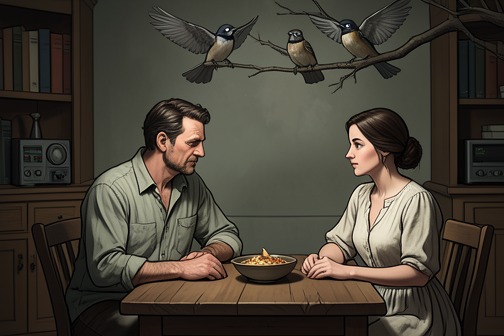
[Tad](entity:character-recall-character-tad-32dcd4a4c202) woke late after the exhausting case and went to the [Library of Love](entity:location-recall-location-library-of-love-f839de985563), where [Claire](entity:character-recall-character-claire-a8a181f2052b) was sharing a meal with [Nan](entity:character-recall-character-nan-8b3a0b065eb0), [Sev](entity:character-recall-character-sev-26fcb020dce8), [Pip](entity:character-recall-character-pip-adcf1b9353d3), and [Wigamus](entity:character-recall-character-wigamus-72c8ba56f3be). The birds thanked Claire for feeding them, and Pip complained that Tad had eaten without offering anyone food.
[Lady Love](entity:character-recall-character-lady-love-450fd8fb3d25) appeared and revealed that she had deliberately instructed the birds to leave [Tad and Claire](entity:relation-recall-relation-tad-claire-3b666a1dd197) to their own devices. She explained that neither agent was more important than the other and that she had entwined their magic so neither could solve cases alone.
after Lady Love’s revelation
Tad and Claire’s Shared Fate
[Lady Love](entity:character-recall-character-lady-love-450fd8fb3d25) told [Tad](entity:character-recall-character-tad-32dcd4a4c202) that he could not solve cases without [Claire](entity:character-recall-character-claire-a8a181f2052b), just as Claire could not solve them without him. Her revelation ended their competition by making collaboration a magical necessity, though both were still reluctant to admit how much they depended on one another.
[Tad and Claire](entity:relation-recall-relation-tad-claire-3b666a1dd197) returned to their familiar teasing, now with a new understanding beneath it. Their partnership had become an unavoidable part of their work as agents, and their disagreements over romance and science remained unresolved.
later that afternoon
The Cottage Intruder’s Clue
As [Tad](entity:character-recall-character-tad-32dcd4a4c202) walked home, he reconsidered the mysterious break-in at his cottage and realized that the missing or moved objects might connect to seeds rather than jewelry or ordinary valuables. He searched his garden shed and found the green-and-gold lumps he had previously discarded.
Tad hurried to [Claire](entity:character-recall-character-claire-a8a181f2052b) with the objects in his palm and announced that the intruder had been a magical sort, then identified the clue as seeds. The discovery connected the cottage intrusion to the story’s magical themes, though the book ends before the pair fully investigates what the seeds mean.